






Customer Responsibility
Importance and Mission

The Company recognizes that customers are key stakeholders in sustainable lending operations. Responsible and fair lending, protection of personal data, and appropriate customer relationship management are critical factors in building trust, reducing social and reputational risks, and enhancing the financial quality of life for customers in the long term. Therefore, the Company has established the "Market Conduct and Responsible Lending Policy and Guidelines1" and the "Responsible Lending Guidelines" to conduct business with a focus on rights, fairness, and the utmost benefit of customers and consumers.
Supporting the SDGs Goals

Goal 17:

Goal and Performance

Goal
Performance
Goal
Performance
Management Approach
The Company defines management guidelines for customer responsibility by integrating the principles of "Market Conduct and Responsible Lending" into its Corporate Governance Policy, Risk Management, and Sustainability Policy. The Company focuses on providing accurate and transparent information, preventing exploitation, protecting personal data, and systematically managing customer relations to ensure that lending services are appropriate, fair, and auditable throughout the entire debt cycle—from the pre-lending stage, through the lending period, during debt repayment difficulties, to litigation and debt assignment. Simultaneously, the Company promotes good financial discipline among debtors by providing information, terms, and warnings to "nudge" behavior, enabling debtors to manage their own debt effectively, in compliance with the Bank of Thailand's notifications.
The Company manages lending risks arising from vulnerable economic conditions and rapid technological developments by considering the following risks:
- Debt Quality and Repayment Capacity: Lending without assessing true repayment capacity may lead to excessive debt burdens for customers, subsequently impacting the Company's Non-Performing Loan (NPL) risk.
- Cybersecurity and Personal Data Risk: Increased digital transactions expose systems to cyber threats. Inadequate defense systems could lead to data leaks, destruction, or unauthorized alteration, resulting in the exposure of customer personal data and loss of trade secrets.
Implementation
- Prudent Lending: Establish loan evaluation processes that carefully consider the customer's purpose for borrowing and repayment capacity, reducing risks according to the "Know Your Customer (KYC) Policy2" to prevent transactions with customers who may be involved in illegal activities.
- Transparency: Disclose interest rates, fees, and contract terms in a clear, transparent, and easy-to-understand manner.
- Data Protection: Collect, use, and disclose customer personal data in accordance with relevant laws and standards, and implement security measures to protect data and control access appropriately.
- Grievance Mechanism: Provide convenient and accessible channels for customers to contact and file complaints. Establish a systematic, fair, transparent, and auditable complaint handling process. Complaint data and feedback are analyzed to improve operational processes and continuously elevate service quality.
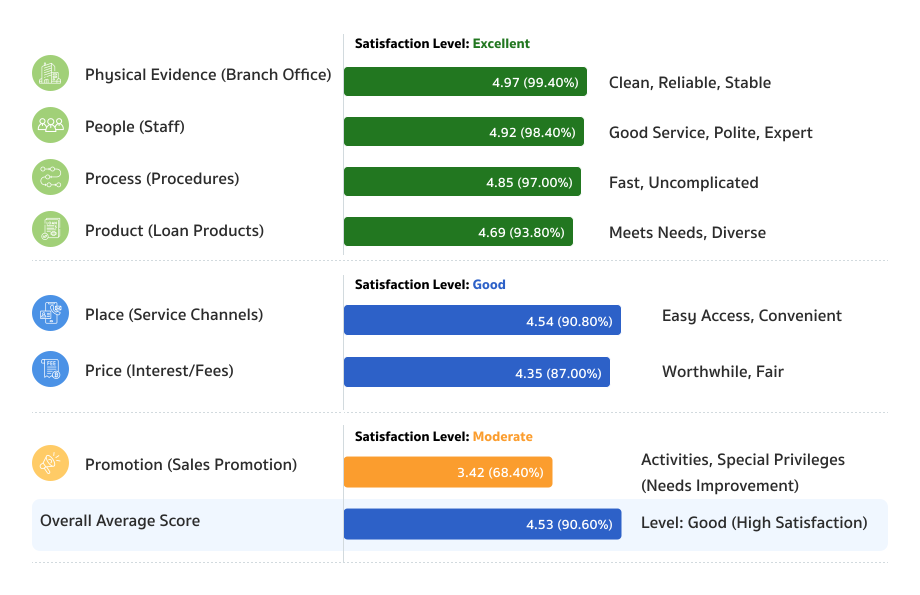
- Customer Satisfaction: Conduct regular customer satisfaction surveys and analyze the results to develop products, services, and staff performance.

Performance Summary
- Prudent Lending Review: The Company reviews its loan evaluation processes by considering the purpose of the loan and repayment capacity. This involves KYC procedures, credit checks, and the use of Credit Scoring to determine appropriate loan limits aligned with the customer's income and necessities. Field visits to the domicile of loan applicants are also conducted to ensure the customer's existence, the validity of the loan purpose, and sufficient repayment capacity from reliable sources. Furthermore, the Company sends SMS alerts to customers in advance of their due dates to "nudge" financial discipline and prevent default.
- Transparency and Disclosure: The Company discloses interest rates, fees, and contract terms to customers before every loan application by providing accurate information. Branch staff must present a "Sales Sheet" detailing the product, including the Effective Interest Rate, fees, and default conditions, clearly before signing any contract. Mandatory tied selling is strictly prohibited, and the Internal Audit department monitors compliance with the Market Conduct policy and responsible lending guidelines. Additionally, the Company discloses information on its website (https://saksiam.com/home) for each type of loan, specifying product characteristics, qualifications, required documents, and interest rates, allowing customers to apply online for follow-up appointments.
- Data Privacy: The Company collects, uses, and discloses personal data from all loan applicants with their explicit consent. In 2025, there were zero cases of personal data violations or leaks resulting from cyberattacks or operational negligence.
- Complaint Handling: The Company received 12 complaints regarding lending services. All cases were resolved, and assistance was provided to the customers in every instance.
- Customer Satisfaction: The Company conducts customer satisfaction surveys, utilizing the results to develop products, services, and staff performance, with a target satisfaction level of not less than 70%.
Stakeholders Directly Impacted
