






Corporate Governance and Organizational Structure
Importance and Mission

The Company prioritizes good corporate governance and an appropriate organizational structure as fundamental factors for sustainable growth. Specifically, the Board of Directors plays a crucial role in determining the direction, strategy, and oversight of Environmental, Social, and Governance (ESG) issues to align with the organization's long-term goals. Therefore, the Company emphasizes good corporate governance and a transparent organizational structure, which are vital foundations for building trust among all stakeholder groups. This is particularly important in our retail loan, agricultural loan, and Nano-finance businesses, which rely heavily on public trust and fair service provision (Market Conduct).
Supporting the SDGs Goals

Goal 10:


Goal 16:

Goal and Performance

Goal
Performance
Goals
Performance
Goals
Performance
Management Approach
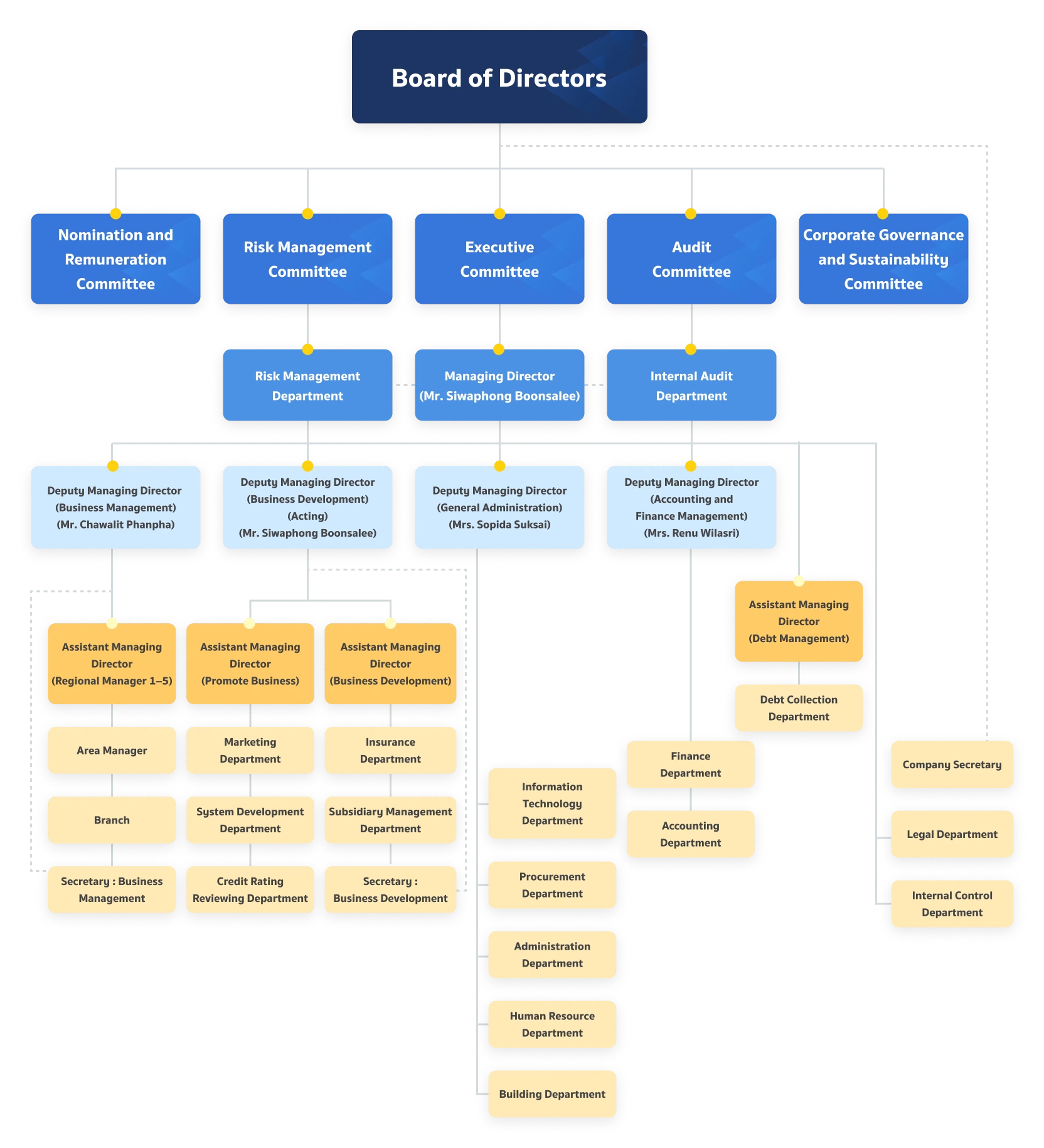
The Company has established a corporate governance framework in accordance with the principles of good corporate governance. The Board structure is designed to be appropriate in terms of independence, diversity of skills (Board Skills Matrix), and experience. The Corporate Governance and Sustainability Committee serves as the core body in integrating Environmental, Social, and Governance (ESG) issues into the corporate strategy, ensuring the effective long-term oversight of ESG risks, opportunities, and impacts.
Operations
- Established the Good Corporate Governance Policy1 as a framework for management and decision-making by the Board of Directors and the executive team.
- Determined an appropriate Board structure, taking into account the independence, diversity, and expertise necessary to drive the organization and its sustainability initiatives.
- Assigned specific roles and responsibilities to the Board of Directors and relevant sub-committees to oversee the organization's strategy, risk management, and sustainability issues.
- Integrated ESG factors into strategy formulation, investment considerations, and performance monitoring processes.
- Conducted regular performance evaluations of the Board of Directors to review the appropriateness of its structure and its role in corporate governance.
- Communicated corporate governance information and the Board structure transparently to all stakeholders.

Performance
- Comprehensively reviewed the Good Corporate Governance Policy as scheduled to ensure the governance system remains up-to-date, transparent, and in strict alignment with corporate governance principles and assessment criteria.
- The Company established a Board structure featuring an Independent Director as the Chairman. The Board currently comprises 5 Independent Directors out of a total of 13 members, representing 38.46% of the entire Board of Directors.
- The Board of Directors assigned the Corporate Governance and Sustainability Committee (a sub-committee) to oversee sustainability, and the Risk Management Committee to oversee risk strategies. ESG strategy is actively driven (ESG Oversight), with ESG performance monitored and reported to the Board of Directors' meetings on a quarterly basis.
- Identified material business issues (Materiality) and utilized them as a framework to address stakeholder expectations in formulating the business plan for the upcoming year.
-
The Board of Directors conducted its annual performance evaluation on both a group and individual basis for the year 2025 to review the appropriateness of its structure and governance roles:
- Board of Directors' self-assessment (Group): 91.99%
- Board of Directors' self-assessment (Individual): 91.33%
- Executive Committee's self-assessment (Individual): 94.86%
- Chief Executive Officer's (CEO) self-assessment: 74.15%
- Fully disclosed information regarding corporate governance and the Board structure across multiple channels, including the Annual Report, the Sustainability Report, and the Company's website.
Board Independence and Composition Proportions
In alignment with the Good Corporate Governance Policy, the Board of Directors ensures strict operational independence from the management team and maintains an optimal proportion of female directors. The structural proportions are detailed in the table below:
| Board Structure and Composition Proportions (Total of 13 Directors) | |
|---|---|
| Executive Directors (4 Directors) | 30.77% |
| Non-Executive Directors (9 Directors) | 69.23% |
| Independent Directors (5 Directors) | 38.46% |
| The Chairman of the Board of Directors is an Independent Director | Yes |
| The Chairman of the Board and the Chief Executive Officer (CEO) are separate individuals | Yes |
| Female Directors (8 Directors) | 61.54% |
Recruitment and Selection of Directors
The Company prioritizes a transparent, fair, and merit-based recruitment and selection process for directors. This ensures that the Board of Directors comprises individuals with the knowledge, capability, experience, and diverse perspectives necessary to align with the Company’s strategic direction and comply with Good Corporate Governance principles. The Company actively promotes Board Diversity across gender, age, professional expertise, and specialized experience to support comprehensive and sustainable strategic decision-making. This commitment is publicly disclosed under the Board of Directors Qualifications and Nomination Policy2.
Director Nomination and Selection Process
The Company emphasizes a transparent nomination process aligned with Good Corporate Governance and Board Diversity principles. The core criteria and processes are detailed below:

Nomination Policies and Criteria
The Nomination and Remuneration Committee selects qualified candidates based on the following frameworks:
- Board Skills Matrix: The committee evaluates the essential combination of knowledge and expertise required to drive the Company’s strategies, specifically focusing on core business operations, finance, technology, and sustainability.
- Diversity: The Company fosters diversity within the boardroom, encompassing gender, age, skills, and experience without limitations on gender, race, or religion.
- Independence: Directors must strictly meet the independence qualification criteria stipulated by the Securities and Exchange Commission (SEC) and the Company’s corporate bylaws.
Operational Procedures
The nomination process consists of 4 key phases to ensure the selection of the most suitable individuals:

Preparation
The Secretary to the Nomination and Remuneration Committee gathers data on the current Board Skills Matrix, monitors director rotation schedules, and reviews mandatory qualification criteria to present to the Nomination and Remuneration Committee for planning.
Analysis of Required Board Skills:
The Nomination and Remuneration Committee reviews the existing skills of the current directors to identify the exact qualifications required for new nominees. This evaluation spans 10 core dimensions: Operations, Finance/Accounting, Strategy, Technology, Legal, Investment, Corporate Management, Crisis Management, Good Corporate Governance, and Human Resource Management.
Director Qualification Criteria
Nominees must possess no legal prohibitions, and consideration is given to personal attributes, requested professional expertise, and board diversity. The Board should collectively possess macroeconomic management capabilities, specialized industrial expertise, and sound proficiency in Environmental, Social, and Governance (ESG) aspects.

Sourcing of Directors
Shareholder Recommendations
The Company provides a window for minority shareholders to propose annual general meeting (AGM) agenda items and nominate qualified director candidates in advance, typically from October to November of the preceding year, ensuring a notice period of no less than 2 months prior to the AGM.
Candidate Sourcing Channels:
The Company identifies qualified candidates through the Directors’ Pool of the Thai Institute of Directors Association (IOD), internal recommendations from current board members, or external executive search consultants.
Screening
The Company thoroughly verifies candidate backgrounds, general qualifications, and potential Conflicts of Interest. This screening applies to shareholder-nominated individuals or candidates discovered during supplementary searches initiated when the Board Skills Matrix analysis reveals gaps in mandatory knowledge, experience, or diversity.

Selection
The Nomination and Remuneration Committee (excluding members with potential conflicts of interest) filters the qualifications of shortlisted nominees, performs detailed background checks regarding conflicts of interest, and reviews their alignment with the Company's sustainability strategies before submitting recommendations to the Board of Directors.

Election
- Retiring by Rotation: The Board of Directors presents the endorsed nominees to the Annual General Meeting of Shareholders for election on an individual director basis.
- Interim Vacancies: In the event that a director seat becomes vacant for reasons other than rotation, the Board of Directors is authorized to appoint a replacement director (except when the remaining tenure of the vacancy is less than 2 months).
2025 Performance Summary: In 2025, the Nomination and Remuneration Committee reviewed the Board Skills Matrix of all 13 active directors and concluded that their collective qualifications and experience completely satisfied the Company’s strategic demands. For the 2025 AGM, the Company granted minority shareholders the right to nominate director candidates from October 2, 2024, to November 30, 2024. As no nominations were submitted by shareholders, the Nomination and Remuneration Committee recommended the re-election of the retiring directors for another term, which was submitted to the 2025 Annual General Meeting of Shareholders for final approval.
Determination of Board Remuneration
The Company enforces a clear, transparent, and fair Policy on Board Remuneration that directly corresponds with the directors' scope of duties, accountability, and the Company’s current financial status. All remuneration packages undergo structured review and filtering by the Nomination and Remuneration Committee. The committee benchmarks rates against peer companies of comparable size within the same financial services industry, while factoring in the Company's business growth scale and operating performance to ensure that remuneration remains competitive, appropriate, and legally sound to attract and retain high-quality directors.
Sub-Committees
To optimize operational efficiency and safeguard strict independence from executive management, the Board of Directors has established 4 specialized sub-committees (excluding the Executive Committee) to oversee key strategic pillars and strengthen institutional stability:
Proportion of Independent Directors on Sub-Committees
| Sub-Committee Proportion of Independent Directors / Total Members (Persons) | Sub-Committee Proportion of Independent Directors / Total Members (Persons) | Independent Director as Sub-Committee Chairman |
|---|---|---|
| Audit Committee | 3/3 | Yes |
| Nomination and Remuneration Committee | 2/3 | Yes |
| Risk Management Committee | 1/3 | Yes |
| Corporate Governance and Sustainability Committee | 3/4 | Yes |
Stakeholders Directly Impacted

Shareholders

Employees

Customers

Partners

Creditors

Community and Society

Government Agency and Organization
